
Henderson emails on Tuesday. They need their order by Friday. It's a good customer and a reasonable ask, and the answer is sitting somewhere inside your business right now. The trouble is that it's sitting in three places at once.
Sales has the customer's email. Operations knows whether there's a rush slot this week. Finance knows that rush pricing needs sign-off before anyone says yes. Nobody is missing anything. The answers exist. They're just scattered.
What a simple question actually costs
Here's how "Can we deliver Henderson by Friday?" usually goes in a small company. Sales pings operations. Operations checks the schedule, then asks whether pricing has been approved. Finance is in a meeting. Someone says, "Dave usually handles rush jobs," and Dave is out until Thursday. By the time the pieces come back together, a day is gone and the customer has been told "let me check" twice.
None of this shows up as a line item on your books, but it adds up. A 2022 Grammarly study with The Harris Poll put the cost of poor communication at roughly $12,500 per employee per year. As a rough illustration, that rate adds up to more than $180,000 a year for a 15-person company.
The problem usually isn't that nobody knows. It's that nobody can see all of it at once.

One question, all the context
A company brain changes where the question goes. Instead of a chain of messages between departments, anyone on the team asks once, and the brain answers from the same sources those departments would have checked: the customer email, the delivery schedule, the pricing policy.
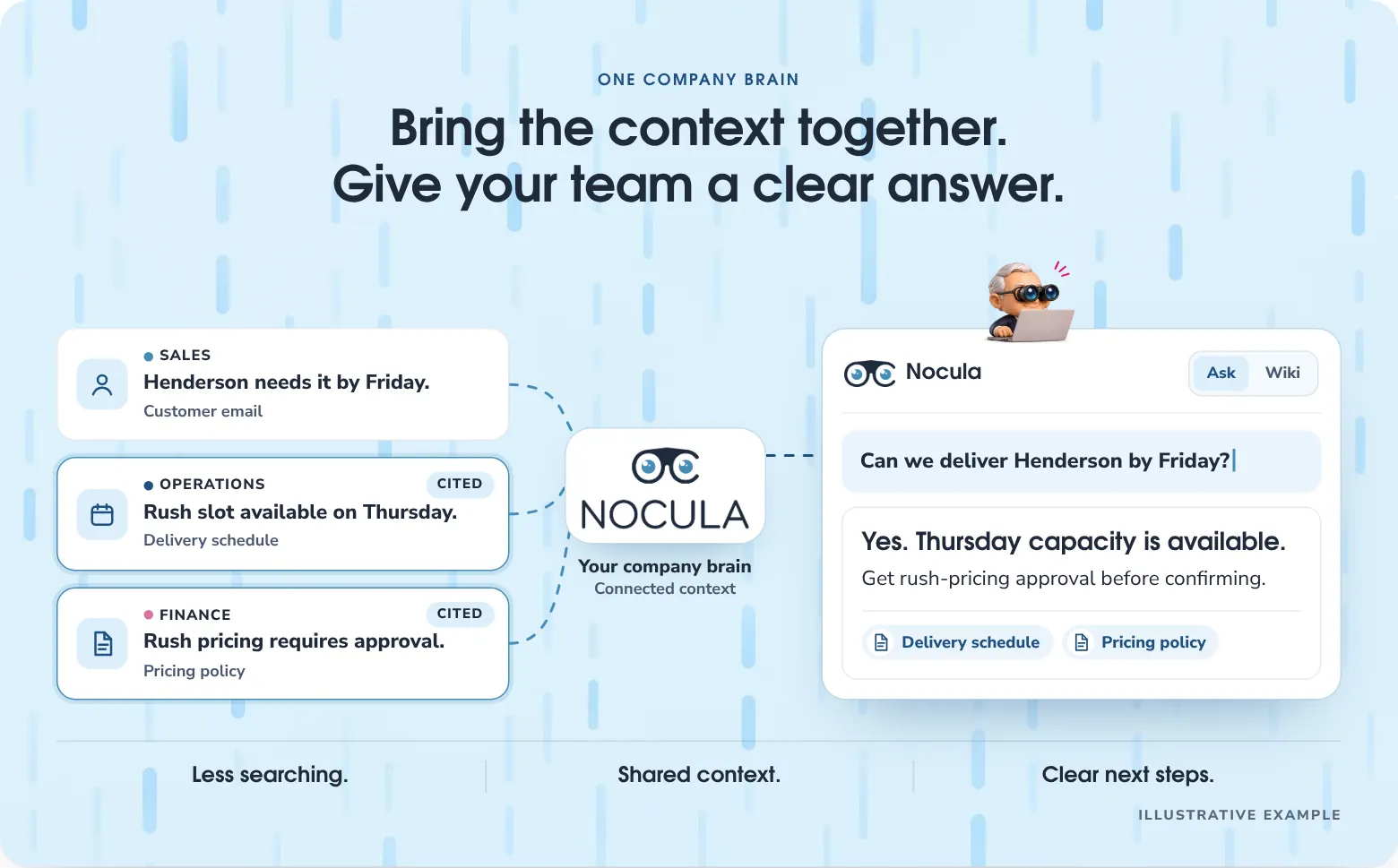
Notice what the answer does and doesn't do. It says yes, because Thursday capacity exists. It also says what still has to happen, because the pricing policy says rush jobs need approval. And it shows where each part came from, so the person asking can click through and check rather than take it on faith. That's the difference between an answer and a guess.
From "who knows?" to "here's the path forward"
The real win shows up when the question is a little messier. "What do I need to confirm Henderson's rush order?" isn't a yes-or-no question. It's a checklist that crosses three teams, and in most companies it lives in one person's head.
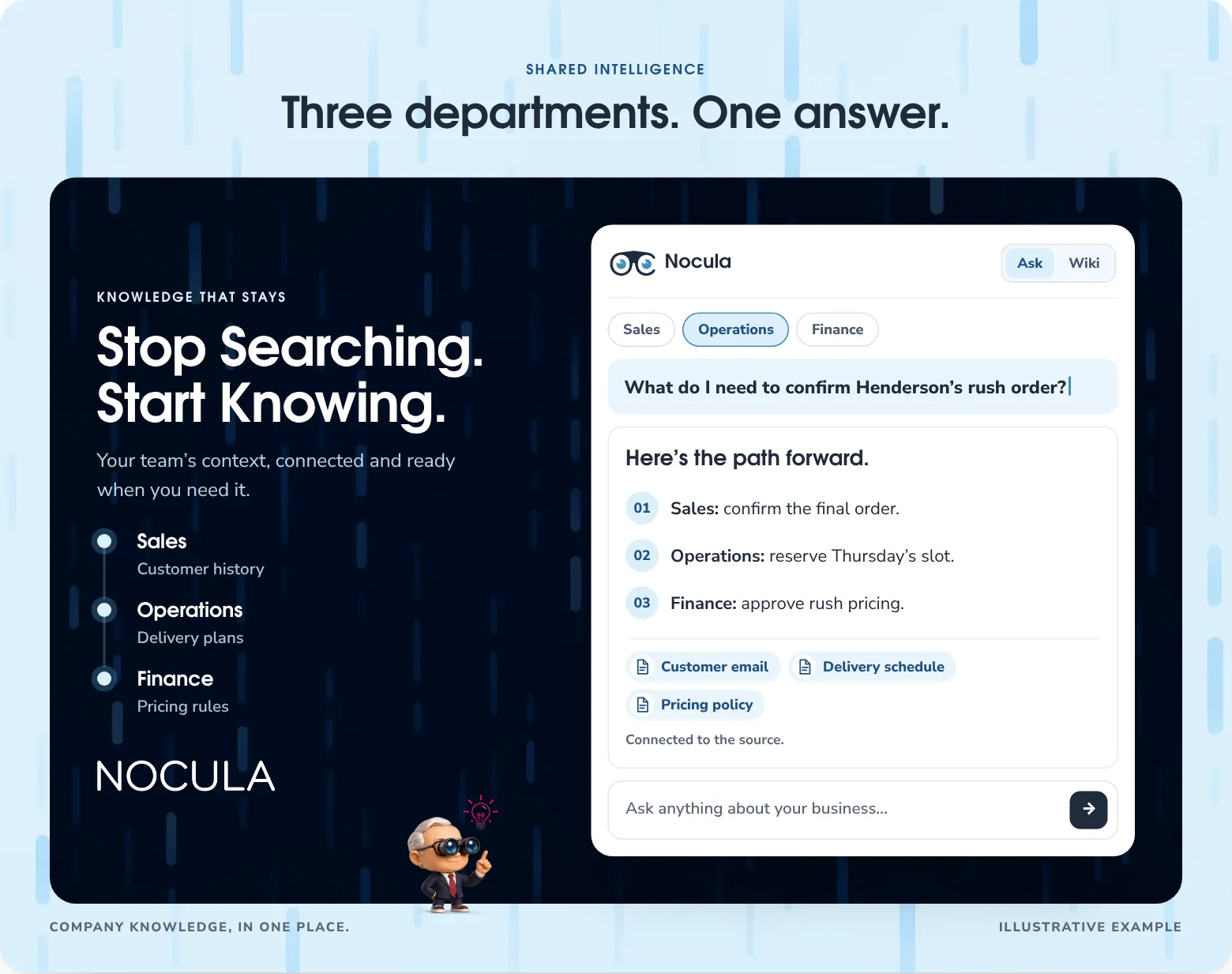
Asked once, the brain lays out who does what: sales confirms the final order, operations reserves the slot, finance approves the pricing. The people still do the work and make the calls. What disappears is the hour of chasing to find out what the work is.
What changes for the team
- Less searching. The question goes to one place instead of three inboxes and a hallway conversation.
- Shared context. Sales, operations and finance see the same answer, drawn from the same sources, instead of three partial versions.
- Clear next steps. The answer includes what still needs a human decision, so nothing gets promised before it's approved.
- Knowledge that stays. When Dave is out, or moves on, the way Dave handles a rush job is still there for whoever asks next.
The guardrails matter as much as the answer
A brain that knows everything is only useful if it respects who's asking. Finance's margin data shouldn't appear in a warehouse lead's answer just because it's relevant. Nocula is built so each person, and the AI itself, only sees what that person is already allowed to see, and every answer points back to its sources. You can read more about how that works on our security page.
It also helps to be clear about what the brain is for. It's there to put the facts and the steps in front of your team, fast. Decisions such as approving rush pricing stay with the people who own them.
Where to start
You don't need to connect everything on day one. Pick one question your team asks every week that crosses departments, the "can we deliver by Friday?" of your business, and start there. If the answer is scattered across a few systems and one person's memory, it's a good candidate.
If you'd like help finding that first question, a short AI assessment, included with every Company Brain, maps where those answers live today and where a company brain would pay off first.